The Universe Hums
The vacuum of space is not empty. It carries a faint background energy — so small it is barely measurable, yet large enough to shape everything that exists.
When you pluck a guitar string, touching it in most places kills the note immediately. Touch it at exactly the right spot — halfway along, or a third of the way — and the note rings clear and sustained. The vibration fits: the wave returns to exactly where it started, reinforcing itself rather than cancelling out. Only certain vibrations survive. Everything else disappears.
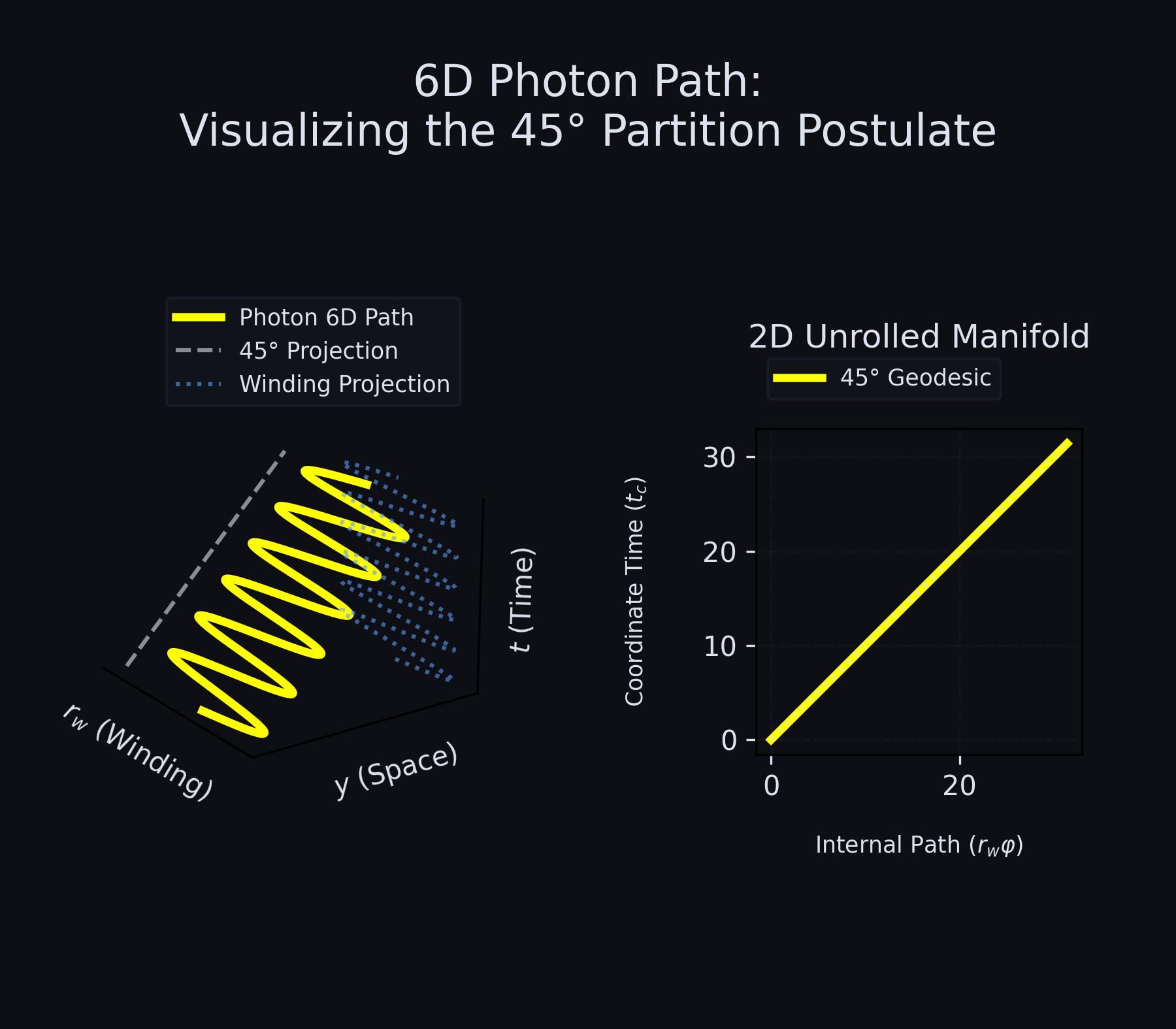
The same principle governs matter. A photon — a packet of pure light — travels through the universe at speed $c$. Under the right conditions, instead of flying in a straight line, it bends back and closes into a loop. When the loop fits perfectly, the light returns to exactly where it started and locks in place. It cannot unwind without releasing at least as much energy as it contains. That stable loop of light is the electron.
The Shape of Stability
A soap bubble always forms a sphere — not because it was told to, but because a sphere holds a given volume of air with the least possible surface area. A soap film stretched across a wire loop becomes a flat circle for the same reason. Nature settles into whichever shape costs the least energy.
In three dimensions, the stable shape is a sphere.
These are the only two options nature allows.
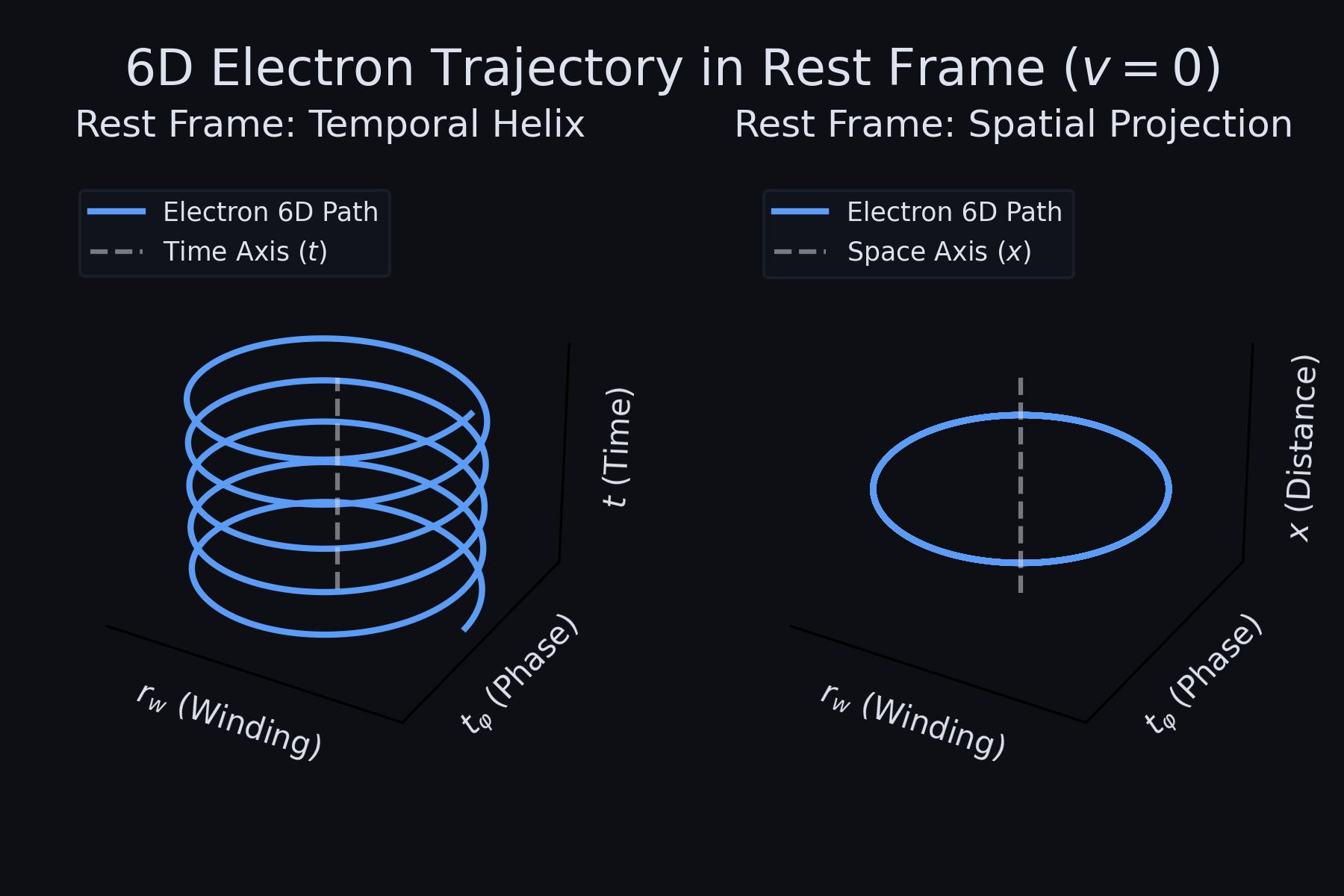
Photon loops obey the same rule. A photon closing into a loop on the phase surface — the hidden geometric layer described in the Phase-Surface Hypothesis — settles into a circle. Three photon loops combining across three perpendicular directions of space settle into a sphere. Any other arrangement either collapses or unravels. This is why exactly two stable free particles exist:
One photon loop closing in a single plane. Its mass is set by how tightly the circle fits on the phase surface.
Three photon loops, one along each direction of space, combining into a sphere. Far heavier, but equally stable.
Three Strings, One Chord
A single guitar string vibrating at its natural frequency rings clearly — one loop, one plane, one note. This is the electron.
Three guitar strings, each strung in a different direction — left-to-right, up-and-down, and front-to-back — vibrating at exactly the right frequency simultaneously reinforce each other and form a stable three-dimensional pattern. This is the proton.
The proton is three strings in perfect harmony.
Two strings or four do not produce a stable closed shape in 3D space. Only one or three. Nature plays very few notes, but plays them perfectly.
In Tune with the Universe
The background energy of the universe sets the pitch a stable loop must match. The electron's loop radius is not arbitrary — it is the one size at which the loop's internal energy exactly balances the outward push of the vacuum. Too small, the loop unravels. Too large, and part of it breaks off. Somewhere close? It accelerates - it speeds up or slows down; this difference in kinetic energy allows it to reach equilibrium with the local environment. At rest, only one size fits, and that size determines the electron's mass.
The vacuum acceleration is fixed by the expansion rate of the universe $H_0$ and the dark energy fraction $\Omega_\Lambda$. In the Forte model, $\Omega_\Lambda = 1/\sqrt{2}$ — a prediction of the 6D geometry, not a number fitted to data:
Predicting the Electron Mass
With the loop radius fixed by the equilibrium condition, the electron mass follows from the energy of the photon loop. Every quantity on the right-hand side comes from a completely independent experiment — none were chosen to make the equation work:
The 1.87% gap reflects the current uncertainty in $H_0$. Running the equation in reverse — using the measured electron mass to predict $H_0$ — gives:
Sits between the Planck (67.4) and SH0ES (73.04) measurements.
The Proton Mass and $6\pi^5$
Each of the proton's three photon loops simultaneously traces a path through 3D space and through the phase surface, contributing two factors of $\pi$. Three loops give six factors of $\pi$. Dividing by the single $\pi$ of the electron's circle gives the mass ratio:
The factor of 6 comes from the three directions of space, each contributing 2 because only half the photon loop lives on the phase surface at any moment — a result established in the Phase-Surface Hypothesis. Each power of $\pi$ corresponds to one independent circular motion in the 6D geometry. Not one factor was chosen to match the observed ratio.
Why This Matters
For a century, the masses of the electron and proton have been measured with extraordinary precision but never derived from first principles. They are numbers we look up, with no explanation for why they are what they are.
Matter is not a fundamental ingredient of the universe — it is light that has found a stable loop. Particle masses are not arbitrary constants but geometric necessities, as inevitable as the shape of a soap bubble. The expansion rate of the universe, the mass of the electron, and the fraction of the cosmos made of dark energy are not three separate mysteries. They are three expressions of the same underlying 6D geometry.
Forte sees math equations as a natural way to describe equilibrium. Nature always looks for a way to find the perfect equilibrium, where trapped photons want to achieve perfect harmonics - the good vibrations that make up our universe.
Did you find this article interesting? Read my previous article on 6D Physics: The Phase-Surface Hypothesis.