The Phase-Surface Hypothesis
A Geometric Unification of Quantum Mechanics and Gravity by Frank Forte
A Geometric Unification of Quantum Mechanics and Gravity by Frank Forte
Physics currently tells two different stories. There is the smooth, predictable world of General Relativity (Gravity), and the jittery, probabilistic world of Quantum Mechanics. For a century, we have tried to force these two stories together without success.
The Phase-Surface Hypothesis proposes a new solution: The "weirdness" of Quantum Mechanics isn't magic. It is simply movement through dimensions we haven't been measuring.
To understand the new theory, we must first understand how Einstein described the universe. Imagine a vast, frozen lake. We have an ice skater named Alice.
The standard equation for the "Invariant Interval" (the true distance in spacetime) looks like this:
d: This stands for "change". If you put it in front of another variable, it means the amount that variable changes. We aren't looking at where Alice is, but how much she has moved from point A to point B, or how much she has aged.
S (State/Interval): This is the total geometric "distance" through the universe. In Relativity, this value must be the same for everyone watching.
c (Speed of Light): This is the speed limit of the universe. It acts as a conversion factor, turning time into a distance.
t (Time): This is observable time. dt is how many seconds ticked by on the clock while Alice moved.
x (Position): This is Alice's location on the ice and dx is how many meters Alice glided across the ice. We usually use (x, y, z) to describe a position in 3D space (length, width, height). To simplify the math, we just consider one direction (x) and change (dx).
This equation works perfectly for cars, planets, and galaxies. But when Alice becomes the size of an electron, this equation fails. It cannot explain why she has "spin" or why she acts like a wave.
The Phase-Surface Hypothesis suggests that Alice is doing more than just gliding. She is performing a complex pirouette that standard physics ignores.
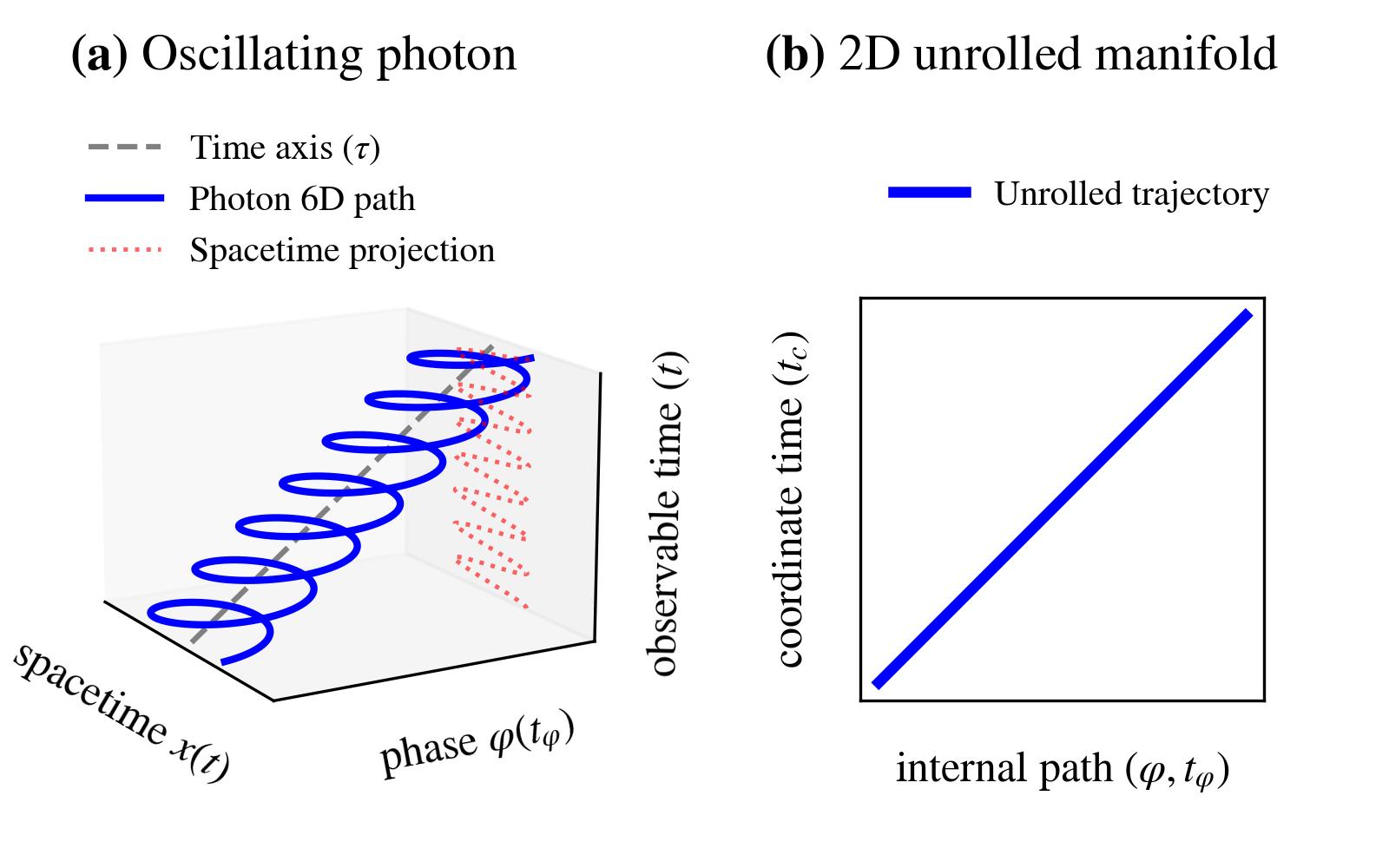
We don't just live in 4 dimensions. We live in 6. The "Complex Plane" of Quantum Mechanics is actually a physical surface—a Phase-Surface—that Alice rotates through.
To fully describe Alice, we need to add terms to Einstein's equation to account for this hidden dance:
ℓf (The Fundamental Length): This is the "stride" of the skater. It is the smallest physical unit of the Phase-Surface. For an electron, this is related to its wavelength. It connects the tiny world of the skater to the macroscopic world of the ice.
R (Amplitude/Radius): This represents the 6th Dimension. Think of this as Alice's "Wingspan." If she stretches her arms out wide (Large R), she has a high probability amplitude—she is "loud" in the quantum field. If she pulls them in (Small R), she is "quiet."
φ (Phase Angle): This represents the 5th Dimension. It is the angle of her spin. A full 360-degree rotation (2π) constitutes one "tick" of her internal clock. This internal rotation is what creates Mass.
When we look at an electron, we usually only see the "Glide." We miss the "Pirouette." But it is the energy of this spin that gives the electron its mass, and the extension of the arms that creates the electric field.
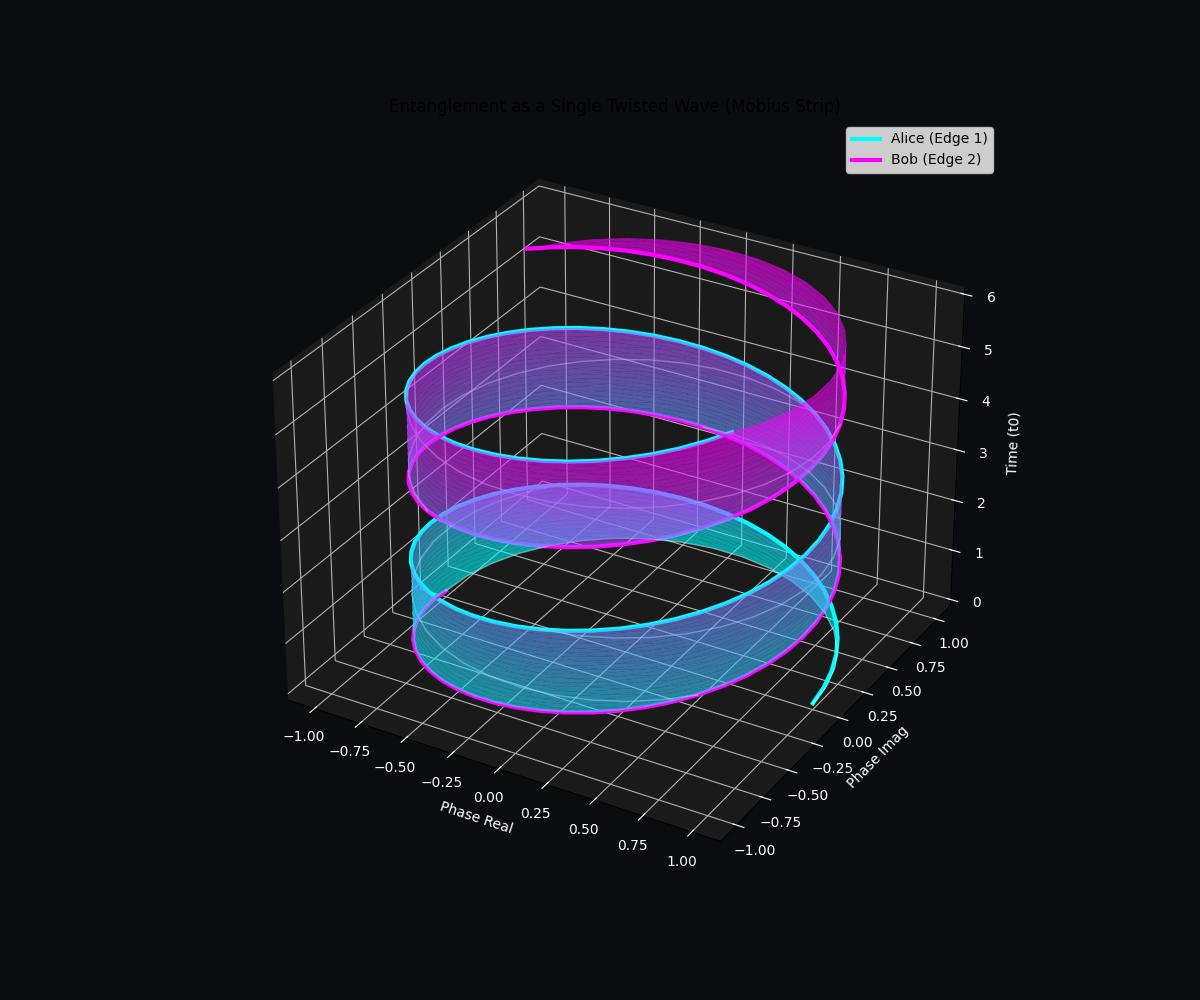
One of the deepest mysteries in physics is Entanglement. If Alice and Bob interact and then separate, they remain perfectly synchronized. Standard physics calls this "Spooky Action at a Distance," as if they are sending magical signals to each other.
The Phase-Surface Hypothesis offers a simpler explanation: They are not two particles. They are one wave.
The Skater's Belt Analogy:
Imagine Alice and Bob are skating miles apart, but they are both wearing the same long Belt.
How they spin depends on the shape of the wave (the Belt) connecting them:
They don't need to "communicate" to know which way to spin. The geometry of the higher harmonic wave they inhabit forces them into alignment. They are simply the two ends of a single, vibrating structure stretched across the 6th dimension.
This framework provides a geometric derivation for the Cosmological Constant and further evidence of the de Broglie internal clock..
Read the Full PaperDid you find this article interesting? Read my follow up article on how light becomes matter.